
OC Has No Downtown. Its 42 Miles of Coastline Might Be the Closest Thing.

Comment

OC Has No Downtown. Its 42 Miles of Coastline Might Be the Closest Thing.

Orange County has 34 incorporated cities and no dominant center — a fact that shapes almost everything about how the county actually functions, dating included. But it does have one continuous, physical thread running through nearly the entire length of it: 42 miles of Pacific coastline, stitched together by Pacific Coast Highway, from Seal Beach in the north down through Huntington Beach, Newport Beach, Laguna Beach, and Dana Point in the south. If Orange County has anything resembling a shared social spine, the coast is it — the one corridor that both halves of a genuinely fragmented county actually use.

It's worth being precise about what that coast actually is, though, because it isn't one thing either. It's three or four very distinct towns strung along the same highway, each with a completely different social personality — which means even the county's closest thing to a unifying center is really just a more concentrated version of the same fragmentation running through the rest of OC.

Three beach towns, twenty minutes apart, three different scenes

Huntington Beach is Surf City USA by trademark and by reputation — a 9.5-mile stretch of wide, walkable sand, a working pier, and a population near 200,000 that makes it the most populous beach city in the county. It's louder, more casual, and more accessible than its neighbors to the south, with a beach-path culture built around board shorts and beer more than blazers.

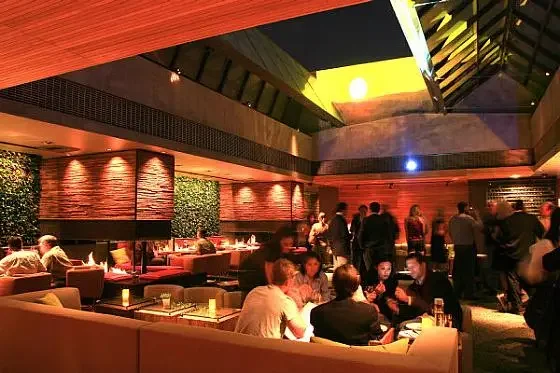
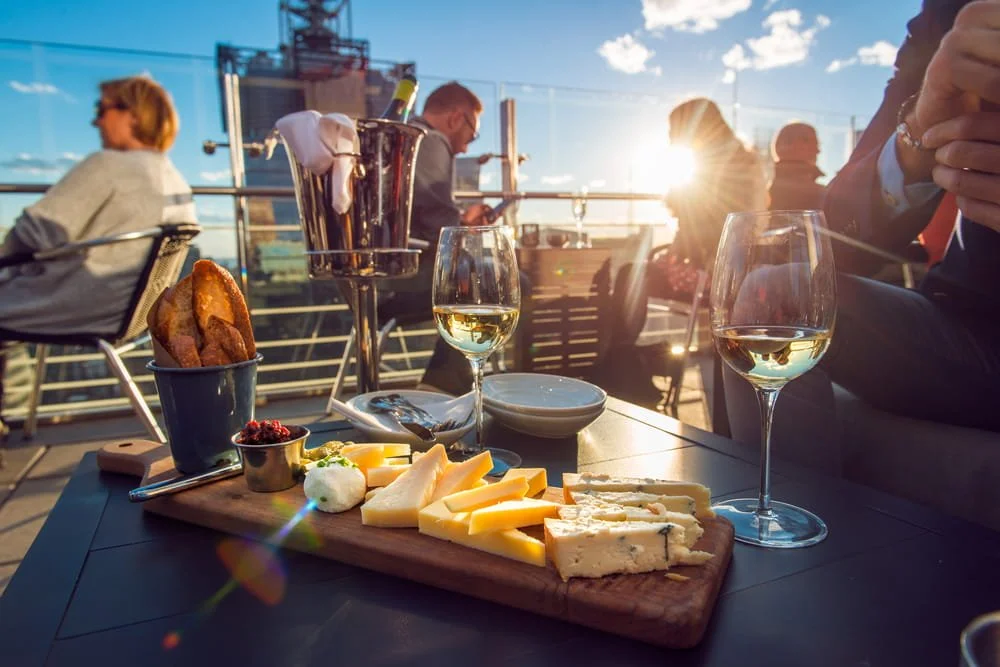
Newport Beach, roughly fifteen minutes down PCH, is a different register entirely — a working harbor city of about 80,000 spread across peninsulas and islands, built around one of the largest recreational boat harbors on the West Coast, anchored by Fashion Island's upscale shopping and a rooftop-bar social scene that skews considerably more polished than Huntington's.

Laguna Beach, another twenty minutes south, is smaller still — roughly 23,000 residents across ten square miles of cliffside coves, reachable in places only by stairway, with an arts-colony identity dating back a century and a social scene built around galleries and hidden coves rather than boardwalks or yacht clubs.

Twenty driving minutes separate each of these towns from the next, and each one is, in practice, its own dating market with its own unwritten dress code, price point, and social tempo — Surf City's casual boardwalk energy has very little in common with Laguna's gallery-hop quiet or Newport's harbor-and-blazer polish, even though all three sit on the same highway, in the same county, forty minutes from each other by car.

What this means for anyone actually trying to meet someone

An app's radius search treats all three towns as roughly interchangeable — close in miles, technically "nearby." Anyone who's actually spent a Saturday in each of them knows that's not quite true. A match who lists Huntington Beach and a match who lists Laguna Beach may be a twenty-minute drive apart and functionally describing two different social worlds, in the same way North and South OC split along income and density even though nothing marks the line on a map.

This is the coast doing, in miniature, exactly what the rest of Orange County does at a larger scale: providing genuine geographic proximity without genuine social continuity. The 42 miles of coastline are real, continuous, and shared. The dating cultures strung along them aren't.

Where a fixed point actually helps

This is precisely the kind of fragmentation a single, well-chosen venue is built to cut through. Relish's Orange County evenings run at FLOE Lounge in the Irvine Marriott — inland rather than coastal, and deliberately so, since a location equidistant from Huntington's boardwalk energy, Newport's polish, and Laguna's quiet doesn't ask anyone to identify with one beach town's specific social code before they've even arrived. A curated evening pulls people out of whichever twenty-minute stretch of PCH they call home and puts them all in the same room, on the same terms, for one night.

Matching still happens afterward through Relish Select, the platform at events.mycheekydate.com — private selections submitted at the end of the night, mutual interest connected the next day. The venue does the work of neutralizing the coast's own internal fragmentation before the conversation even starts.

What OC's coastline actually says about dating here

Forty-two continuous miles of coastline sounds, on paper, like exactly the kind of shared geography that should knit a fragmented county together. In practice, it's closer to a highlight reel of the same problem playing out at a smaller scale — three or four genuinely different social worlds, twenty minutes apart, connected by a highway but not much else. A radius filter can't tell the difference. A single room, chosen specifically to sit outside any one town's particular code, can.

Relish hosts structured social evenings across Orange County, and offers curated matchmaking through Luvo. Find an evening near you →

Comment

OC Has No Downtown. Its 42 Miles of Coastline Might Be the Closest Thing. | The Edit: Orange County Edition
The Most Planned City in America Has a Dating Problem

Comment

The Most Planned City in America Has a Dating Problem

Irvine is not a city that grew. It's a city that was designed — the entire 93,000-acre Irvine Ranch master-planned from scratch starting in 1960 by architect William Pereira and the Irvine Company, organized into a series of self-contained "villages" radiating out from the new UC Irvine campus, each with its own schools, parks, and shopping built within walking distance. The city has been named America's safest large city by the FBI for 13 consecutive years running. Under longtime chairman Donald Bren, the company has controlled architectural details down to permitted roof tile materials, approved shrub palettes by village, and window placement on single-family homes — reportedly redoing residents' exterior choices personally when they didn't match his standards.

It is, by a wide margin, the most deliberately engineered city in this entire series. And Relish's Orange County evenings happen to run right in the middle of it, at FLOE Lounge in the Irvine Marriott — which makes Irvine's specific brand of extreme planning worth understanding, because a city built this intentionally changes the mechanics of meeting someone new in ways a more organically grown city simply doesn't.

A city built for families, not for strangers

The village system is the core of the Irvine Master Plan, and it's genuinely effective at what it was designed for: each village — Woodbridge, Turtle Rock, Northwood, University Park, and dozens more — functions close to a self-contained small town, walkable to a school, a park, and a shopping center without ever needing to leave. That's an intentional, well-executed design goal, and it's a meaningful part of why Irvine consistently ranks among the best cities in the country for families and safety.

It's also, structurally, a design built around containment rather than mixing. A resident of one village can genuinely go days without any real reason to cross into another — work, school, groceries, and recreation are all designed to be satisfiable within a five- or ten-minute walk of home. Compare that to a denser, more organically grown city, where a lack of amenities within a neighborhood forces people out into shared, mixed spaces more often almost by necessity. Irvine's planning removes a lot of that necessity by design, which is a genuine quality-of-life win for a family raising kids and a structurally different starting point for two strangers hoping to cross paths.

The HOA layer adds a second kind of insulation

Most of Irvine's neighborhoods are governed by homeowners associations that the Irvine Company itself set up decades ago, complete with company-issued handbooks on maintenance standards, and rules that still shape daily behavior today — closed garage doors, restricted street parking, specific approved exterior colors. None of that is about dating directly, but it's part of a broader pattern worth naming: Irvine is a city where a great deal of social behavior has been formally standardized and enclosed, village by village, well beyond what most American cities attempt.

The result isn't that Irvine residents can't meet people — the city is genuinely diverse, highly educated, and full of accomplished professionals, which is exactly why Relish and a range of national matchmaking firms operate there. It's that the city's own design logic, so effective at producing safety and stability, doesn't especially prioritize the kind of unplanned, cross-village social friction that tends to be where people meet each other by accident in less engineered places.

Why a curated evening fits this specific city particularly well

This is the one structural feature of Irvine that a curated evening addresses almost by definition. A structured evening does deliberately, for one night, what Irvine's village system doesn't especially encourage on its own: it pulls people out of their own self-contained pocket of the city and puts them in a single room with others who live an entirely different daily radius, in a city genuinely built to make that unnecessary most days. At FLOE Lounge, guests aren't limited to whichever village happens to have the closest bar — the room draws from across Irvine and the broader OC business corridor.

Matching still runs through Relish Select, the platform at events.mycheekydate.com: private selections submitted at the end of the night, mutual interest connected the next day. The mechanics are the same as anywhere else in this series. What's different is what the evening is correcting for — not sprawl, not a ratio, but a city that was engineered, on purpose and quite successfully, to make bumping into a stranger less necessary than it is almost anywhere else in America.

What Irvine's design actually says about dating here

Most cities in this series have a geography problem that happened to them — sprawl that grew unplanned, a ratio shaped by an industry, a housing market that reacted to demand. Irvine's is the rare case where the containment was the point, engineered deliberately by a single company pursuing safety and stability, and succeeding at it by nearly every measure that gets tracked. That's a genuine achievement for the people who live there. It also means the kind of accidental social mixing that fills in the gaps in most cities' dating markets isn't really built into this one — which is exactly the gap a single, deliberately curated evening is built to close.

Relish hosts structured social evenings across Orange County, and offers curated matchmaking through Luvo. Find an evening near you →

Comment

The Most Planned City in America Has a Dating Problem | The Edit: Orange County Edition
Real Cost of Dating in OC: Apps vs. Matchmakers 2026

Comment

Real Cost of Dating in OC: Apps vs. Matchmakers 2026

Orange County isn't a city. It's 34 of them, incorporated separately, with no single downtown anchoring the county the way downtown LA anchors Los Angeles — the county's three largest cities, Anaheim, Santa Ana, and Irvine, are all roughly comparable in size, and none functions as a clear center of gravity for the other 3.2 million residents.

The county also runs on a real internal fault line most outsiders miss. Northern Orange County — Anaheim, Santa Ana, Fullerton, Garden Grove — is denser, younger, more ethnically diverse, and less wealthy, with more renters and a political lean that's shifted Democratic. Southern Orange County — Irvine, Newport Beach, Mission Viejo, the master-planned communities pushing toward the county's southern edge — is newer, wealthier, more heavily homeowner, and more Republican, built largely around HOA-governed planned developments rather than organic neighborhoods. Median household income across the county sits above $116,000, among the highest of any large county in the state, but that figure obscures how differently North and South OC actually live, spend, and — relevantly here — date.

This isn't a minor geographic footnote. It's the reason "dating in Orange County" is a considerably less coherent phrase than "dating in Chicago" or "dating in Boston" — there's no single center of gravity, no single culture, and, per app radius filters, no reliable way to know whether a match five miles away lives in a starkly different economic and cultural reality.

The apps: the same subscription, a county with no center to filter around

App pricing in OC tracks the national range — Tinder Plus, Hinge+, and Bumble Premium fall between $15 and $60 a month depending on tier, with the usual pattern of stacking two or three to widen a pool that's already unusually fragmented by geography. A standard radius search doesn't know or care whether it's crossing the county's real North/South line — a match that shows up as "12 miles away" could mean two people who live functionally similar lives in adjoining South OC suburbs, or two people separated by one of the widest income and lifestyle gaps in Southern California, with a radius filter treating both cases identically.

OC's sprawl compounds this in the same way it does in Dallas, Houston, or Phoenix — the county has no meaningful rapid transit connecting its 34 cities, so a match on the wrong side of the county, regardless of which side of the cultural line they're on, can mean a real drive before a first date starts.

Matchmakers: a market genuinely born in Orange County, not just serving it

Unlike most of the cities in this series, Orange County isn't only host to national matchmaking franchises — it's the founding home of at least one firm that's since gone global. Cinqe Matchmaking was founded in Newport Beach in 2010 and has since expanded to serve clients across the country and internationally, with Orange County private-client searches still a core part of its business; pricing for its premium tier begins around $25,000. Match By Julia, founded locally in 2009, prices packages from $7,500, with a $510 database-only membership available for those not ready for an active search. Kelleher International, Selective Search, Enamour, and It's Just Lunch all maintain an Orange County presence at their typical national rates — Kelleher from $30,000, Enamour from $20,000. VIDA Select offers month-to-month packages from about $1,595. On the more boutique end, Orange County Singles has operated locally for more than 25 years with fully customized, undisclosed pricing.

Against that range, Luvo's three published packages — $3,250, $5,250, and $7,500 — sit at the accessible end of Orange County's market, while including a founder consultation and curated introductions sourced from people the team has actually met through its own live events rather than an unvetted database. It isn't attempting to compete with Cinqe's national reach or Kelleher's six-figure ceiling. It's a considerably more accessible way into human-sourced matchmaking, in a county where even the locally-founded firms assume real budget.

Structured events: one room that ignores the county's dividing lines entirely

Relish's Orange County evenings run at FLOE Lounge in the Irvine Marriott Hotel — a deliberate anchor point in the heart of the county's business corridor, reachable from both the northern and southern halves of OC without asking anyone to cross the county on a hunch that their match lives a compatible enough life to be worth the drive. A ticket runs in the same general range as other major Relish markets, typically high $30s to low $40s, for 8 to 12 in-person introductions in a single evening.

This is the one format in Orange County that sidesteps the North/South fragmentation problem by design rather than by accident. A curated guest list, built around shared criteria rather than zip code, means the room does the work an app's radius filter structurally can't — everyone who shows up has already cleared the same bar, regardless of which of the county's 34 cities they happen to call home. At roughly $3–4 per introduction, it's cheaper than a stacked month of app subscriptions and a fraction of even Orange County's most accessible matchmaking tier.

Matching runs through Relish Select, the platform at events.mycheekydate.com: private selections submitted at the end of the night, mutual interest connected the next day, no public rejection and no algorithm pre-deciding who gets shown to whom.

What the Orange County math actually says

Most cities in this series have one geography problem to solve — sprawl, a ratio, a season. Orange County has a structural one: it was never built around a single center, and the real cultural and economic line running through the middle of the county doesn't show up on any app's radius filter. Matchmaking here spans genuinely homegrown Orange County firms to national names charging the usual six-figure ceiling. The structured evening remains the one format built around a fixed point that both halves of the county can reasonably reach — which, in a county this fragmented by design, might be the most useful thing on this list.

Relish hosts structured social evenings across Orange County, and offers curated matchmaking through Luvo. Find an evening near you →

Comment

Real Cost of Dating in OC: Apps vs. Matchmakers 2026 | The Edit: Orange County Edition
Relish

Elevated, structured social evenings and curated introductions for professionals who move with purpose. 19,477+ verified events across 50+ cities since 2014.

Evenings
How It Works Find Your City About Relish Relish Select Relish The Good The Edit
Introductions
Relish Introductions Luxury by Luvo
Trust & Legal
Verified Event History Is Relish Legit? Transparency The Relish Standard Conduct & Safety Things Worth Knowing Behind The Room Refund Policy Privacy Policy Terms & Conditions