Every city has a food culture. Chicago has a food argument.
Not a pretentious one — Chicago is structurally incapable of pretension about food, which is part of what makes it interesting. The argument is not about which restaurant is fashionable or which chef is ascending or which neighbourhood has the most interesting new opening, though Chicago has opinions on all of these. The argument is about whether food matters. Whether it is worth caring about. Whether spending a Tuesday evening at a place that has been doing one thing for thirty years and still does it better than anyone is, as a way of spending a Tuesday evening, one of the things that makes a life in Chicago worth living.
The answer, for most Chicagoans, is yes. And this shapes dating here in ways that are specific, observable, and unlike anything we see in other cities.
The food scene as a form of self-expression
Chicago was awarded 21 Michelin stars in 2026, across restaurants that range from the three-star tasting menu at Alinea on the near north side to the Bib Gourmand recognition at Taqueria Chingón in the West Loop, Mott St in Wicker Park, and Daisies in Logan Square. The range is significant: this is not a city that has decided fine dining is the only dining worth caring about. It is a city that has decided that doing something excellently — whatever that something is — is worth recognising.
The practical consequence for dating is that the restaurant choice carries more information in Chicago than in most cities. Not status information — that is the New York and LA reading of the restaurant as social signal. Something more specific: values information. A first date at Sepia, the Michelin-starred West Loop institution with a $125 four-course prix fixe that represents some of the best value in starred dining in the country, signals something about how a person thinks about pleasure and worth. A first date at The Violet Hour in Wicker Park — the cocktail bar that helped define the American craft cocktail movement and still makes some of the best drinks in the city — signals something else entirely, equally deliberate. A first date at North Pond, tucked into Lincoln Park beside the nature sanctuary with its farm-to-table menu and genuine quiet, signals something different again.
In Chicago, where you choose to eat is a form of autobiography. The choice reveals what you pay attention to, what you value, whether you have done the research or simply repeated what is famous. Chicagoans notice the choice, even when they do not say so.
Fulton Market and what it has become
Fulton Market District — the stretch of what was until a decade ago a meatpacking and cold storage corridor between Halsted and Ogden — is in 2026 the most concentrated zone of serious dining in the Midwest, and by some measures in the country.
Randolph Street, the main artery, runs through restaurants that represent almost every serious culinary tradition: Avec's Mediterranean small plates and the bacon-wrapped dates that have been on the menu since 2003 and still justify their existence; Publican's whole-animal butchery and exceptional beer programme; Girl & the Goat, Stephanie Izard's exuberant, genre-spanning menu that has drawn lines since it opened and continues to deserve them; la Serre, the sun-drenched Provençal greenhouse that opened in 2025 and has already become the kind of room that makes an evening feel like somewhere specific rather than just dinner; Curtis Duffy's two-Michelin-starred Grace in the Fulton Market proper, where a multi-course tasting menu represents the kind of cooking that justifies the word serious.
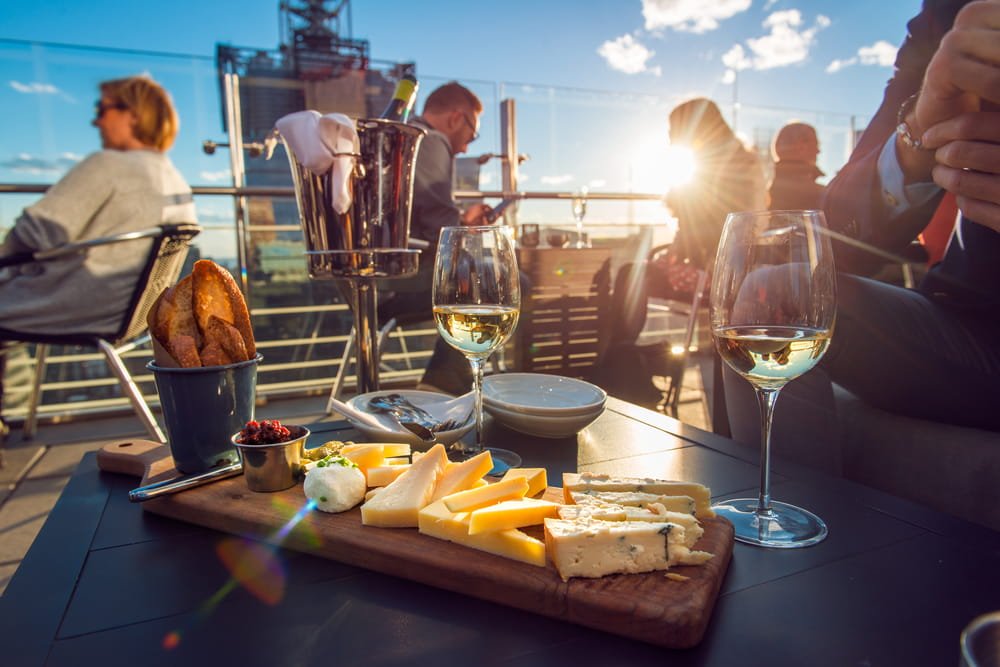
A first date on Randolph Street in the summer — the city having finally delivered the weather that justifies its ambitions, the outdoor terraces open, the light doing what it does in Chicago in June over the skyline to the east — is not merely dinner. It is a demonstration of what Chicago has built here, and of what it is capable of when it decides that something matters.
The conversation at a table in this part of the city tends to run longer than it was supposed to. This is, we suspect, not entirely coincidental.
The cocktail bar as a first-date institution
If the Fulton Market restaurant is the deliberate choice — the evening that signals intention and investment — the Chicago cocktail bar is the first-date institution that its coastal equivalents have never quite replicated.
The Violet Hour on Damen in Wicker Park opened in 2007 and helped establish the vocabulary of the modern American cocktail bar. The entrance — unmarked, a curtain behind a nondescript door — is still one of Chicago's most quietly theatrical social rituals. The Aviary in the West Loop, from the Grant Achatz and Nick Kokonas team behind Alinea, takes the cocktail as a form of cooking so seriously that the experience requires a reservation and produces drinks that arrive in ways that defy the category. The Milk Room, the eight-seat bar tucked inside the Chicago Athletic Association on Michigan Avenue, is perhaps the most intimate serious drinking experience in the city — a room so small that the conversation between strangers is almost structurally inevitable.
These are not bars in the casual sense. They are places that require a decision to visit and reward the decision with an experience that provides, among other things, an excellent reason to talk. The cocktail bar in Chicago has evolved, across two decades of serious investment by the city's hospitality community, into one of the best first-date environments in the country: intimate enough for a real conversation, interesting enough that there is always something to say about what you are drinking, and — in the Chicago way — honest enough about what it is that you never feel you are performing by being there.
What the food scene reveals about the city's daters
The relationship between Chicago's food culture and its dating culture is not merely that they share geography. It is that they share values.
Chicago's food scene is built on the premise that genuine quality, consistently delivered, to people who care about it, is worth more than fashionable novelty or social performance. The city has Michelin stars at every price point. It has restaurants that have been open for decades and are still the best at what they do. It has a culture that notices and rewards the difference between a place that takes its work seriously and one that takes its profile seriously.
Chicago's dating culture operates on the same premise. The city's professionals — across industries, across neighbourhoods — bring to dating the same quality that characterises the food scene at its best: genuine engagement, directness, the willingness to invest in something because it is worth investing in rather than because it looks impressive. The first date in Chicago is less often an audition than it is in New York or LA. It is more often a dinner.
Since 2014, Relish evenings in Chicago have found their venues in exactly the social infrastructure that the city's food and cocktail culture has built: the private dining rooms on Randolph Street, the intimate cocktail spaces in Wicker Park, the restaurants that feel like a neighbourhood even when they have a Michelin star. The food is not incidental. It is, in the Chicago context, part of what makes the evening real.
Relish hosts structured social evenings for driven professionals across Chicago since 2014. Browse upcoming Chicago evenings →